The Doctrine of Signatures
Before modern chemistry, herbalists looked to the plants themselves for clues. This ancient philosophy, known as the Doctrine of Signatures, posits that the Creator marked each plant with a physical "signature" that indicated its purpose. "Like cures like," the ancients whispered, believing that the color, shape, and habitat of a plant revealed its medicinal affinity.
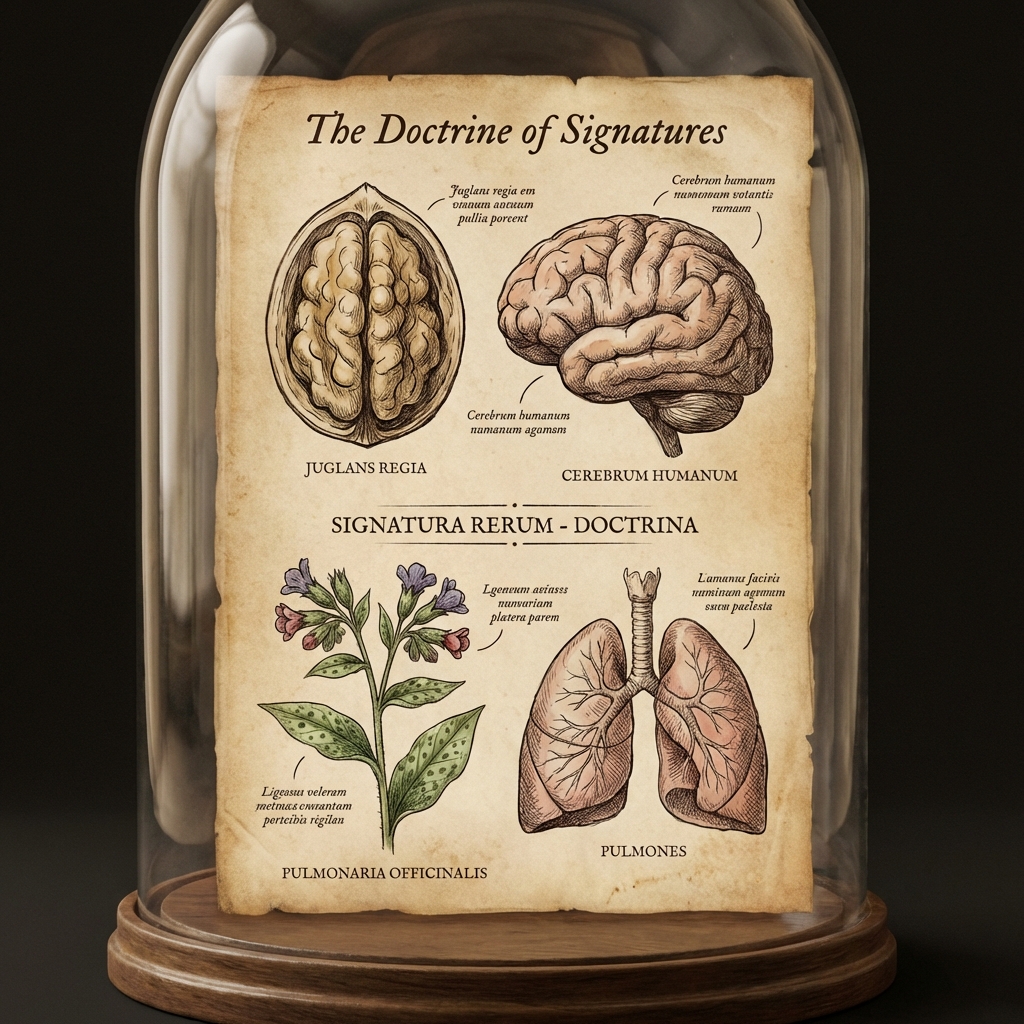
As Above, So Below
The famous alchemist Paracelsus championed this idea, claiming that nature was a book written by God, waiting to be read. While not a fail-safe scientific method, the accuracy of these signatures is often startling.
Signatures in the Wild
- Walnut (Juglans regia): Perhaps the most famous example. The hard shell resembles a skull, and the kernel inside is wrinkled and bi-lobed, perfectly mimicking the human brain. Modern science confirms that walnuts are rich in Omega-3 fatty acids, crucial for brain health.
- Lungwort (Pulmonaria officinalis): The leaves of this plant are speckled with white spots, resembling diseased lung tissue. For centuries, it was used to treat chest infections, coughs, and asthma.
- Eyebright (Euphrasia officinalis): The flowers of this tiny plant resemble a bruised or bloodshot eye. It remains a primary herbal remedy for conjunctivitis and eye strain.
- Horsetail (Equisetum arvense): This ancient plant grows in jointed segments that resemble a spine or bone structure. Rich in silica, it is indeed a powerful builder of bone, hair, and nails.
A Mnemonic Device?
Today, we might view the Doctrine not as a divine law, but as a brilliant mnemonic device created by our ancestors. In a world without written textbooks, associating the "bone-like" stem of Horsetail with bone healing ensured that vital knowledge survived through generations. It is a reminder that if we look closely enough, the natural world often speaks to us clearly.